Showing posts with label Commuting. Show all posts

Sunday, April 17, 2011

Commuting: Riding in Naples is Safe?!

When I talk to people about biking in Italy, often times the first thing that comes up in the conversation is the question of safety: is it safe to ride on the roads?  


Interestingly enough, despite the crazy driving habits of Italians, they are extremely respectful of cyclists.   Everyone I speak to about biking on the roads in Italy is amazed, especially Americans, as driving on the roads can be stressful, so they assume that cyclling on the road would be stressful and dangerous.  Quite the opposite.  Unlike in America where the average driver is cursing at any/all cyclists, the typical Italian driver respects and sometimes admires road-borne cyclists.  What's the difference?  The average Italian views cyclists as sports heroes.  American's wouldn't know cycling was a sport if it wasn't for Lance Armstrong winning 7 straight Tour de France victories.  To analogize, it would be like a Saint Louis Cardinal Baseball player running in the street in Saint Louis; they'd get all the respect and plenty of room from passing cars.  


So, the driving might be a bit crazy in Bella Napoli, but they aren't gunning for you on your bike.  

Commuting: My first ride to work in Napoli, Italia

I've been working a bit closer to home lately, in an office that's located just down the coast from me.  Unlike my usual work location, which is seperated from where I live by a number of tunnels and mountains, the geography separating my new office and home is simpler, and as such, easier to ride.  I've been driving to work the past week or so, but realized early on that my commute was possible by bike.  In fact, as bike commutes go, it's probably the worlds best.  Not counting the traffic, which I get up early enough, prior to most drivers hitting the road, or me.  Kidding. :)


Anyway, the ride is beautiful.  Probably the most beautiful bike commute I will ever have.  My ride allowed me to see much of what I get to see from the car, but it's different on a bike.  Maybe that's because I'm going slower, maybe it's because I'm more exposed to the environment on the bike, hearing and seeing more along my bike commute than I would by car.  Either way, I experience more by bike than by car.  The ride is spectacular, but I'd like to share a few places in particular.  First is the downhill ride from Monte di Procida.  It's particularly long and fast, but it also features an amazing view looking north along the coast.  The morning was so clear that I could see almost to Gaeta, 100km to the north.  Continuing on, I reach Baia, a small port town, and as I turn toward work, I look over the bay of Naples and see the sun rising over Vesuvius.  As I ride toward Pozzuoli along the coastal road perched on a cliff above the bay of Naples, I looked to my right seeing Vesuvio, Sorrento and Capri in the distance.  As I reach Pozzuoli, the foot and motor traffic become much more congested, forcing me to pay more attention to the activity around me.  Although it's busy, Pozzuoli is also a beautiful city.  As I ride over the cobblestone streets, I pass by cafe's, ride through arches and tight city streets and witness the city getting ready for another busy day.  The final spectacular spot along my bike commute route is a short but beautiful stretch of road between Pozzuoli and Bagnoli, where I work.  This route is fairly tight, with the road built between the bay of Naples and a cliff, but the spectacular view looks out over the bay of Naples looking back toward home.  From this vista I see my home in the distance, and as my eye follows the coastline, I can witness the route through Baia and Pozzuoli that I've just completed.  I finish the ride by climbing the road up into Bagnoli, reaching my office in just over a half an hour.  I've really enjoyed my first bike ride to work in Italy.  Wonderful view and a great ride.  ...next time I'll have to stop for a cafe or cappuccino in Pozzuoli...

Thursday, September 25, 2008

Cargo Bike Conversion: First Operational Test Ride!

Well, I rode the single speed cargo bike down to Trader Joe's for the first operational test ride, and all went well. I was able to carry about 47 pounds of food back from Trader Joe's without incident.


My ride is about 2 miles down to the local train station, a short train ride to the shopping center, and about a half mile ride to Trader Joes. Pretty easy ride, with only one major hill to climb on the way back. As such, I was able to handle the increased weight. While the increased weight on the back of the bike was noticable, it was managable riding it home. The bike rack and the ulock securing the bike to the rack held the bike firmly upright as I loaded the cargo container with the grocery bags. Of greater concern is handling the bike after loading it but prior to riding it: It was difficult to handle the bike while unlocking it from the bike rack, manuever it toward the street, etc. The weight on the back made the front very light and relatively unstable side to side, and made me worry that the bike might tip while I was pushing it the short distance from the bike rack to the street. It was a pain balancing the bike while stowing the bike lock in my bag, as the loaded and heavy bike would have created a mess had it tipped at this vulnerable moment. Luckily, nothing did!

Once on the bike, though, it rode well. The cargo container held up, buldging a bit at the bottom, however it suffered no strain great enough to cause white stress marks in the plastic that would indicate potential failure. The bungee cord I used on the top helped hold the lid on, too. The container (Rubbermaid Roughneck) was strong enough to keep the groceries secure and upright. The two bags fit tight enough in the container to keep everything in place without shifting or moving too much.

Overall the system worked well. I look forward to using it on future shopping trips, and would recommend the modification to anyone else that is looking to make their bicycle more practical for short trips. It was easy to manufacture, easy to install, and best of all: easy to remove and place on another bike that has a rear rack mount.

Friday, July 25, 2008

Bicycle Commuting Part V: Selecting a Route

Route selection is key to a fun and safe ride to work. It is important to avoid busy streets, instead opting for quieter streets to avoid traffic that can add risk and stress to your daily commute. In fact, I added about a mile to my current commuting route to avoid a particular street, that while it was a direct route, it was so busy that I felt it was dangerous and the hurried drivers were often irritated by my mere presence. As such, I redirected my route along quieter streets, which is more relaxing, safer, and includes more hills, which I happen to like as it gives me a better workout before and after work.

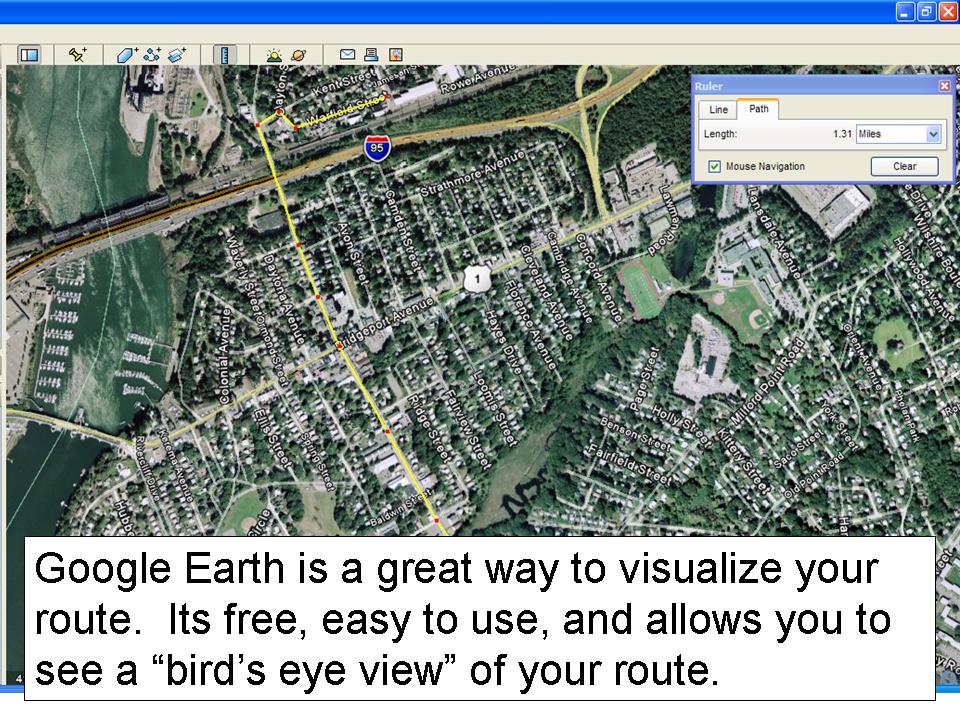
It is best to look at your route on a map, either paper or digital. New web based map applications like Google Earth, Google Maps, or Yahoo Maps work great. Google Earth even lets you plot a path and will give you the distance. While some map websites and software can automatically plot a route, the routes generated are usually not the best, as they are designed for efficient automobile traveling, not safe bike commuting. As such, it is helpful to use the digital maps in combination with your knowledge of the streets and neighborhoods to determine the best route. The digital maps allow you to minimize your commuting distance while helping you to avoid congested, stressful, and potentially dangerous streets.

After examining a potential route, it is best to reconnoiter the route on bicycle prior to riding to work. The route should be pre-ridden to ensure it is safe, that it avoids any unnecessarily busy streets, and most importantly, to determine the amount of time required to get to and from work. If you test ride the route during the weekend, you may notice that traffic may be very different on a Monday morning is very different from when you test rode it on a weekend. Not to worry: adjust your route as necessary. Sometimes I take a different route just to keep the daily ride interesting.

Monday, July 21, 2008

Bicycle Commuting Part IV: Know the Rules of the Road

It is important to know and follow the local rules of the road and laws. I have actually been pulled over on my bike for going through a red light! Crazy as it may seem, police that are interested in your safety may give you a ticket for an infraction. So, know the law, and follow it. I believe most of the traffic related laws are designed to make the road a safe place, so it really is in your best interest.

Laws also refer to the laws of physics, and you need to understand very clearly that according to the laws of physics you are the underdog of the road. If other road users become angry or inconsiderate of you, understand that if any escalation of the event reaches a point commonly referred to as “road rage”, you will probably lose the argument. Physics defines most forward motion as the combination of velocity and mass. Translate that into your bicycle’s speed and the collective weight of you and your bicycle. Now, in a physical (as in physics) contest between you and a motorist, you are likely to lose, even if the car in question is a modest little compact, as their weight and speed is likely to be greater than yours. Therefore, it is in your best interest, regardless of who is right or wrong, to ensure that any situation does not escalate. Some drivers will not have a very good idea as to where the law determines that you ride, but they may have a strong emotional response to where they think you belong. Regardless, it is best to do as the Beatles sang: “Let it be”. I have even gone so far as to apologize to very rushed, rude, impatient, and therefore angry driver. It helps to remember that they are dealing with car traffic, and they may have just come off the highway. They are trying to deal with the stress while not having any means to blow off steam. On the other hand, you are able to deal with stress as you commute on a bike…

So, follow the rules of the road and remember that you are the underdog when it comes to all things related to physics of motion: speed and vehicle weight. So, be safe and enjoy your commute!

Part 5 in the Series: Selecting your Route

Saturday, July 19, 2008

Bicycle Commuting Part III: Customizing Your Bike for Commuting

Whether you have just purchased a bike or are using a bike you already have for commuting, the first thing to do to your bike to get it ready to commute is to make it safe, comfortable, and practical. To be effectively safe, you need to be visible to other commuters, including bikes, cars and pedestrians. I use a couple of common devices to ensure that others on the road are visually and audibly aware of my presence. Lights are the best means to make other commuters visually aware of your presence. Unlike bright clothing, they are active during any time of day or any kind of weather. I recommend two lights, one on the front and one on the back to make you visible to traffic. Lights come in all varieties, however it is best to have lights that blink and bring attention to you. In riding through urban areas, most streets are lit well enough to allow you to see; therefore you do not need to spend hundreds of dollars on the expensive night riding lights. Those systems are designed to allow mountain bikers see in a dark forest. You just need to ensure that motorists are aware of your presence on the street. Your local shop should have a selection of lights available that will allow motorists to see you.


Bike bells are a must. While they may seem either a bit childish, I like to think of it as the bike’s equivalent of the car horn. However, a bike bell is more polite, and much nicer to listen to on a residential street. The bike bell comes in handy to alert motorists at an intersection of your presence. They are also a great way to get the attention of pedestrians or other bicyclists. I use the bell prior to entering and while I am traveling through intersections that have vehicles stopped at signs or lights. It is a great way to get their attention and to ensure for your benefit and theirs that they see you. It is also a great way to alert pedestrians prior to going through a crosswalk. Again, the bike bell is a non-intrusive means to communicate to others of your presence and intention.
If you are commuting to work, shopping center or to school, you will probably need to carry something. There are many ways to carry your necessities on your person or on your bike. There are many types of bags to carry any amount of gear, with the only limitation being how much your back can withstand. Bikes, however, can be outfitted to carry much more weight than you can manage on your own.

Bags come in all shapes and sizes, and there are quite a few designed just for riding on a bike. Courier bags are the most popular and useful. At first glance they appear to be a gigantic purse, with a large bulging rectangular main pocket held at each top corner by a wide strap. The bag is strapped diagonally across the body, with the weight of the bag resting on the lower back. While this may not be ideal for walking or hiking, when the back is angled at 45 degrees and supported over a bike frame, it is a great means of carrying bulky, heavy items. Courier bags come in a variety of sizes and colors from a variety of manufactures. Most are waterproof, and courier bags are an easy way to ensure the items you are carrying stay dry despite wet streets or inclement weather.

Other bags work great, whether backpacks or duffle bags. If it works and is comfortable, use it. If you are concerned about something getting wet, put it in a plastic bag.

Your bike should have a number of mounts or grommets on its frame to allow the mounting of external cargo racks. Some bicycles allow for front and rear racks. Rear racks sit directly above the rear wheel, behind and just below the seat. They also help protect the rider from being splashed by the rear wheel, and act as a sort of fender. Front racks mount around the front tire and mount to the fork. Rear racks are the most useful for commuting and shopping as they allow for the most weight to be carried. Milk crates or other such baskets of metal or plastic construction can be mounted onto the rack to allow lose items to be carried. A milk crate or basket makes your bike very useful for local shopping, whether getting a bag of groceries or a few items at the local hardware.

Propositioning clothing and other gear reduces the necessity to carry gear daily. If your daily commute goes to the same location, your ability to store clothing and shower essentials in a locker room means that you are carrying that much less gear on a daily basis. In commuting situations where I have quite a bit of clothing stashed, I may only have to carry clothing in and out for laundering, not for daily use.

Part 4 in the Series: Rules of the Road

Tuesday, July 15, 2008

Bicycle Commuting Part II: Choosing a Bike for Commuting

There is an infinite selection of bikes from which to choose. However, the needs of the commuter can be more specialized, and as such, four categories should be considered prior to selecting a commuter bike: Size, cost, type and source.

The bicycle you select to ride, for fun or function, should be comfortable and fit you properly. Your local bike shop will have professionals on hand to properly fit you to a bike that will meet your needs. When properly fitted, you should have adequate stand over height, that is, you should be able to easily and comfortably straddle the frame of the bike without causing undo harm to your more sensitive parts. If you do not know what size bike you should ride, this will limit the following category, source.

The source of your bike is an important factor in selecting a commuter bike. Sources include your local bike shop, internet auction, classifieds (online or paper), or even a garage sale. Bike shops are a great place to start, as they will have new and used bikes for you to consider. Many bicycle manufacturers even have purpose built commuter bikes with racks and fenders included. Your local dealer may even have used bikes available, too. Used bikes make great commuter bikes. They are inexpensive, tend to come with accessories, and they already look a little worn, and hence less attractive to any thief. Used bikes can be found at your local bike shop, internet auction website, police auction, or even pawn shop. Of course, if you start looking at used bikes outside of a bike shop, you better know the product you are purchasing and are certain that it will function and fit you properly. If you are concerned about the size, function or customer service aspects of your bike purchase, I would purchase your bike through a shop. I have had good and bad experiences purchasing bikes online through e-classifieds and auctions. However, I have always had great experiences getting a bike through my local bike shop.

A primary consideration of the bike that I commute on is cost. I tend to invest less into my commuter bike than on a bicycle that I use for recreation. At times, this seems counter intuitive, as you may be commuting five days a week on an inexpensive bike, and recreating on a thousand dollar bike one or two days a week. Although your commuter bike may see more use than a bike that is used for recreation, it will also be subjected to the elements for long periods of time. Not only will it be possibly subjected to rain and rust while you ride, but also as it waits for you outside of work or the store. I would define the elements as anything out of your control, including both mother-nature and human-nature. Rain, criminals, snow, bad drivers, pot holes, rust, and criminals are all elements that your bike will be exposed to while you are at work or shopping. Did I already say that criminals will probably be checking out your bike? Well, they will. A great way to eliminate any concern for how the elements will impact your commuter bike is to invest as little money as possible into a reliable bike, conduct regular maintenance to reduce wear and tear, and always lock your bike. Following these three rules will ensure that you get the most out of your commuting experience and investment into your commuter bike. Now, understand that the elements will eventually win. Your chain will wear, components will eventually rust, your bike may eventually get stolen, however, your concern should be to make the elements work as hard as possible to achieve their goal: to destroy your bike. Locking and maintaining an inexpensive bike will ensure that you maximize your investment.

The type of bicycle best for commuting depends upon your style of riding. There are three main types of bikes: road, mountain and hybrid. Road bikes are built for speed on smooth, paved surfaces. They are best at getting you from point A to point B in a minimum amount of time. Their speed and efficiency is due to the large diameter wheels with thin tires as well as a drive train that is designed for speed. However, road bikes do have some disadvantages for those looking to commute. Road bikes tend to be the least comfortable to ride for those not accustomed to their aggressive geometry. Their thin, high pressure tires require frequent examination to ensure proper inflation. Also, their tires do not allow for much ‘fudge factor’, in that a sloppy curb hop or sharp pothole will see you in need of tire repair. Entry level road bikes also tend to be more expensive than other bicycle types. It may be possible to find an excellent deal on a used road bike on Craigslist or at a local garage sale. One of my best commuter bikes was a $20 Trek road bike that I purchased from a neighbor at a garage sale. The bike worked great, was fast, and I was never concerned about theft or wear-and-tear.
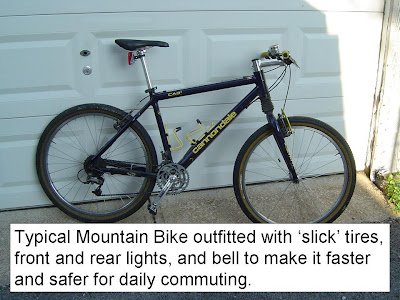
Mountain bikes work well for commuting. Their robust design lends itself well to the urban environment, soaking up punishment from curbs and potholes. They tend to be more comfortable to ride, as they feature less aggressive geometry and can come with suspension forks that smooth out a harsh street. Mountain bikes also feature a drivetrain that is adept at climbing, and while it is not as fast or efficient as a road bike, it tends to make climbing city hills easier and make riding easier for the ‘uninitiated’. It is best to outfit the mountain bike with ‘slick’ tires, or tires with a smooth road tread. This will increase the speed and efficiency of your mountain bike. However, mountain bikes do have their shortfalls, too. They are not as fast as road bikes, and if your commute is a considerable distance (ten or more miles), speed and efficiency may be a major concern for you.

Hybrid bicycles are just that, a hybrid design between a road and mountain bike. They tend to feature the straight handlebar and drivetrain from a mountain bike. Their wheels, however come from touring road bikes, and as such the overall bike tends to ride like a mountain bike while providing more road bike speed. They are a great bike for the city, and there are more types of hybrids available than ever before. Many manufactures are designing urban specific hybrid bikes with mountain bike frames, road wheels and matte black paint jobs to blend in and avoid unwanted attention.

Part 3 in the Series: Customizing Your Bike for Commuting

Monday, July 14, 2008

Bicycle Commuting Part I: Why Commute on a Bike?

Preface
I have been successfully commuting via bicycle for over ten years. I have used my bike to get to work, school and other locations in all seasons during all times of day. I have thoroughly enjoyed the opportunity to do so, as it has given me a sense of doing something positive to better our environment, not to mention saving money that would have been spent on motorized transportation. I have used my bicycle to commute in relatively harsh environments, like Minnesota’s winter or Missouri’s humid summer climates. I have learned how to dress, select the best route, carry my necessary gear or cargo, and how to do it all safely. The following is being written to pass along some of the knowledge/wisdom that I have gained in an effort to teach others how to commute by bicycle.

Most of this text will describe bicycle riding in the context of riding to and from work. The bicycle is just as efficient in long, daily trips as it is in short, variable trips. That is, the bike is great way to go to the local grocer, bar or any other short trip. While most of the tips will be formatted toward bike commuting, they are definitely worthy of assisting someone in using the bike to shop and socialize.

Why would anyone want to commute by bicycle?
This is a great question, and one that you may have to address from time to time from various people, whether co-workers or passersby. Since the act of biking for reasons other than recreation seem difficult to formulate for most Americans, I have written down a few advantages to bicycle commuting:

-Daily exercise integrated into your daily commute
-Avoid the stress of highway traffic
-Relieve stress before and after work
-Save non-renewable resources
-Reduce pollution

The most obvious reasons for biking to work are to get exercise, reduce pollution and reduce resource usage. I thoroughly enjoy integrating my daily exercise into my commute to work. While it may seem inefficient to bike 30 minutes to work instead of driving 15 minutes, considering that if I were to work out after getting home from work for 1 hour, I would have spent 30 minutes driving in traffic and 1 hour in a gym. Instead I choose to spend an hour of my day riding to and from work. In total I save 30 minutes of my day! By biking to work I exercise and commute at the same time, effectively killing two birds with one stone.

Pollution and resources are a hot topic these days. There are theories that gaseous pollution may be making our planet hotter or colder. There are conspiracies that wars have, are being and will be fought over natural resources like oil. Despite the strong feelings and political divide, most Americans tend to drive a lot regardless of their political leanings or beliefs. Nothing depicts a hypocrite like a “no war for oil” or “don’t drill for oil” decal on the back of a four wheel drive vehicle. It is very easy to say what you believe, however it is much more difficult to do or live what you believe. By biking to work, school or to the store, you are living a lifestyle that does not depend so heavily on non-renewable resources. If environmental degradation or resource based conflict is a concern of yours, by biking instead of driving, you are literally putting your money where your mouth is, by not giving money to the industries that generate revenue from oil.

The highways are a very stressful place these days. Road rage and other motorized acts of violence are the result of highway systems that are over tasked, and people incapable of accepting their choice to sit in traffic with everyone else. By biking to work you eliminate the stress of highway gridlock from your life. In fact, since exercise elevates stress, you will actually reduce your work/career induced stress by commuting via bicycle. You will arrive home, exercised and relaxed, ready to spend time with your family.

If you bike to work, the queuing theory states that your karma will improve. According to Queuing theory, a mathematical model used to study and complex waiting lines like internet traffic or highway traffic, by biking to work you will be making everyone else’s commute on the highway easier. Queuing theory states that long and short term impacts on the system (read: traffic) are felt exponentially by any single variable. So, by choosing to drive to work, you make everyone else’s commute exponentially more difficult. Conversely, by getting out of your car and onto your bike, you make everyone’s highway commute exponentially easier. While this may not be a major factor in your decision to commute, it may build your karma or brotherly love with everyone else in your community by simply knowing that by biking to work it makes it exponentially easier for everyone else on the highway to get where they are going.

So, by biking to work you get the benefit of exercise, reduced local and global pollution, reduce the demand for non-renewable resources, reduce the stress in your life and put one less car in the daily traffic jam, making you and everyone else healthier and happier. Now, it is time to go get a bike!

Part 2 in the Series: Choosing a Bike for Commuting